Institute of Astronomy > Laboratory of astrometry > Fields of research > Creating high presize catalogues of positions and proper motions of stars > XC1 catalogue > Some characteristics and features of the current version of the catalogue
Some characteristics and features of the current version of the catalogue.
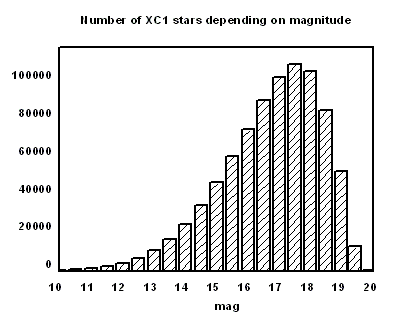
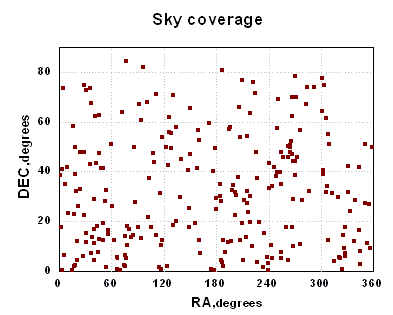
The current version of the XC1 catalogue contains about one million stars in 256 one square degree areas with ICRF sources in the northern hemisphere. In the figures cited below the dependence of amount of stars on the magnitude as well as the distribution of areas in the sky are shown.
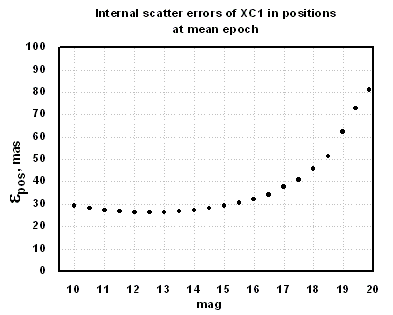
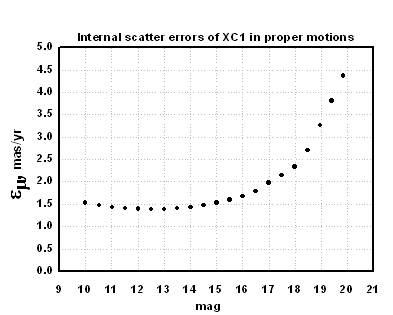
The internal accuracy of the position and the proper motion of each star in individual areas was calculated from differences of dependences of linear approximation of the position on the observation epoch (scatter method). All positions had uniform accuracy and no weighing was used for the solution of equations. Average values of these errors depending on the magnitude are shown in the diagrams.
Positions and proper motions of XC1 stars can include systematic errors associated with the presence of the star colour. These errors are coused mainly by the atmosphere dispersion, which was not taken in account in the current version of the catalogue. Positions and proper motions were dirived from number of observations made in different epochs with different combinations of emulsion/filter (O, E, J, F and N plates). With some combinations emulsion/filter an influence of atmosphere dispersion is negligible (E, F, N plates) but in the case of O (without filter) and J (blue one) plates we saw the dependence of residuals after reduction on the star colour at large zenith distances as well as the caracteristic distribution of differences between optical and radio positions of ICRF quasars as a function of zenith distance. For deriving proper motions the positions from all type plates were used therefore systematic position errors on O and J plates because of colour equation probably contributed to the resulting proper motion errors. As it was mentioned we are going to exclude this colour equation in the next version of the catalogue.
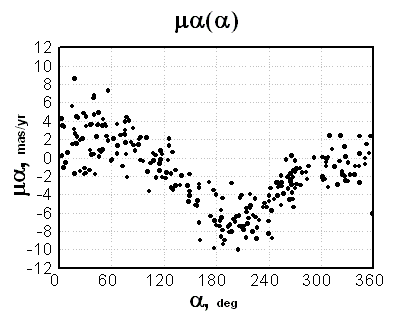
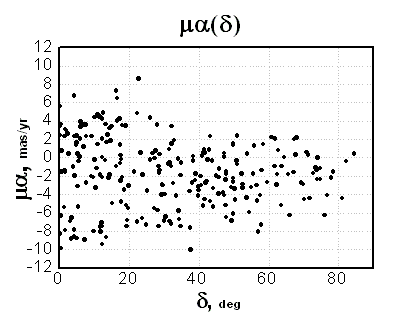
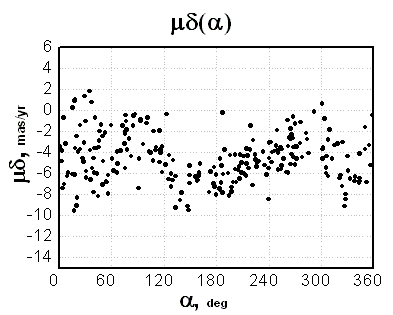
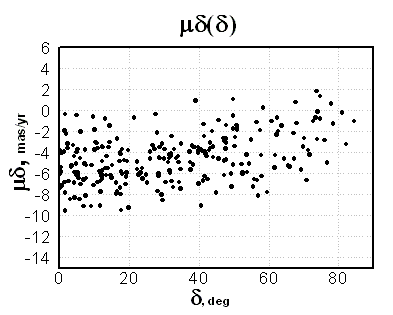
Also we find it interesting to show diagrams which illustrate the distribution of proper motions of XC1 stars in the northern hemisphere. Each point on these diagrams presents an individual field of the XC1 catalogue. To derive these points we selected stars in the magnitude range (15 <= mag <=16) whereupon we calculated the average value of the proper motion mura*cos(dec) and mudec. The diagrams show the distribution of star movements depending on their sky coordinates.
|
|
|
 |
 |
 |
 |
 |
 |