
 UKRAINIAN
NATIONAL PROPERTY OF UKRAINE
Coherent-optical image processor
of Institute of Astronomy, Kharkiv V.N. Karazin National University
History
The Research Institute of Astronomy of V. N. Karazin Kharkiv National University was founded in 2002 on the basis of the University Astronomical Observatory, one of the oldest observatories in Ukraine. Many famous scientists worked at the Observatory. Prof. L. O. Struve was a founder of Kharkiv astrometry, astrophysicist academician V. G. Fessenkov started planetary studies at the Observatory. American astronomer Otto Struve started his scientific career in Kharkiv University; later he headed a number of American astronomical institutions and was a President of the International Astronomical Union. In 1918 academician N. P. Barabashov began systematic optical studies of the Moon. The main results of Kharkiv astronomers were obtained in the field of planetary science.
Recent planetary studies in the Institute use photometric and polarimetric observations of asteroids, comets, Jupiter, and the Moon. Kharkiv astronomers analyze results of space missions to the Moon (Clementine, Lunar Prospector), Mars (Mars Global Surveyor), Venus (Pioneer-Venus, Magellan, Venera 13–16), and Phobos (Phobos-2 mission). Since the end of the 60's several successive efforts were undertaken to develop image-processing facility and algorithms for high-resolution imaging with ground-based optical telescopes. The unique equipment "Coherent-optical image processor" was designed and manufactured in 1973 under the direction of prof. V. N. Dudinov for fundamental investigations in the field of optics, radiophysics, astrophysics, and defense. The instrument was settled in out-of-town Observational Station of Astronomical Institute that is located at 75 km to the south-east from Kharkiv (the equipment needs to be unaffected by any seismic factors).
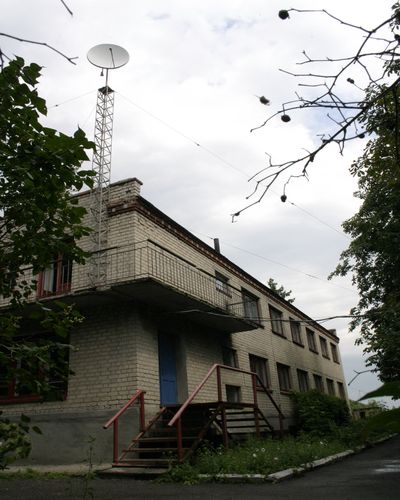
Laboratory building where optical image processor is mounted
Physical principles of processor operation and its optical scheme
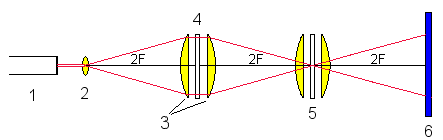
Optical scheme of image processor in mode of linear filtration
1: lazer; 2: expander of lazer light beam; 3: lens-cuvetes; 4: a transparency; 5: corrector for Fourier-spectrum of original images; 6: digital camera
The Coherent-Otical Image Processor (COIP) is an analogue "computer" which allows amplitude and phase-amplitude filtration of images. It incudes high-quality lens that privides Fourier transformation of transparencies that are illuminated by a beam of parallel coherent light. In our instrument transparencies (original images) are placed inside of special lens that are cuvetes filled up with an immersion liquid to reduce of phase noise of the transparencies. These lens-cuvetes are Fourier transformation components of the image processor.
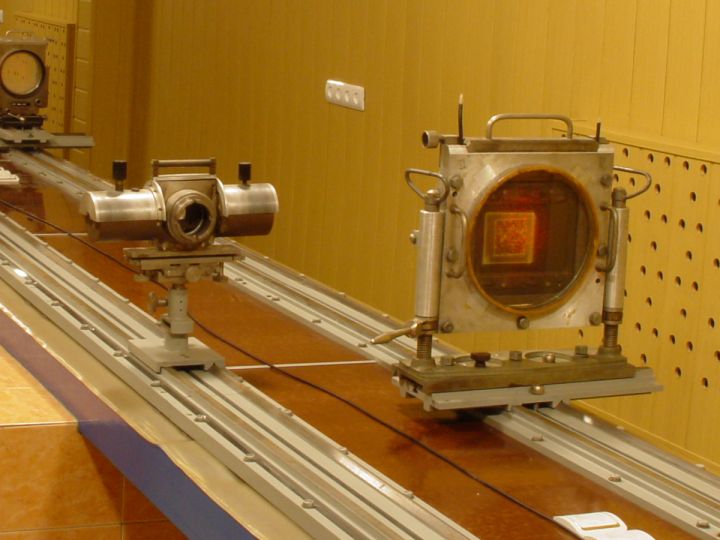
Two versions of lens-cuvetes for transparencies on 36 mm roll-film (left unit) and on photographic plates or wide film for air photography (right unit)
Coherent-optical image processor provides of:
- modeling and investigation of any range complexity optical or radioastronomical systems;
- modeling and investigation of coherent light propagation through stochastically phase- heterogeneous medium;
- receiving and investigation of statistical characteristics (power spectra, correlation functions) of complicated two-dimensions images with high information composition;
- investigation of interference and diffraction phenomena, coherent properties of electromagnetic radiation;
- holographic investigations;
- laboratory practical work on physical optics and adjacent fields for students.
COIP was use for the next real tasks:
- defense activity;
- increase of spatial resolution of Earth-based and spaceborn images;
- discerning artificial space objects;
- analyzing sea surface parameters to reveal submarine tracks.
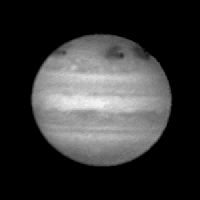
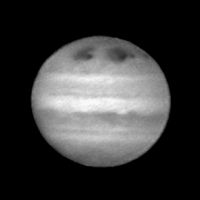
Earth-based images of Jupiter obtained for falling the Levi-Shoemaker comet on the planet. The interval between shoots is 1 hour. Details of the structure in drop places are due to the image processing
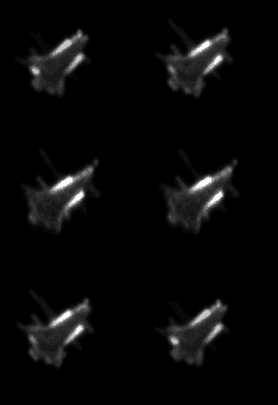
16 image frames of the orbital complex "Mir – Atlantis" as result of Earth-based observation at the distance 200 km. Achieved angle resolution is 0.5"
Methods of specle-interferometry allow us to determine angle distances between components of double stars. The main point of the methods is that the period of interferograms is inversely proportional to the angular distance between the stars. Results of such a method as applied to the task are shown below.
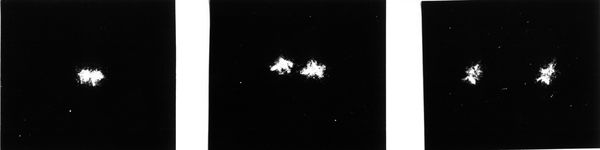
From left to right: Speckle-images of the double stars ε2Lyr (2.3"), 95 Her (6"), and 100 Her (14")
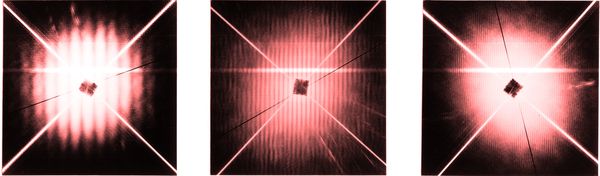
Power spectra of the same images (statistically averaged Fourier spectra that were squared)
The "Coherent-optical processor" is applied in astrophysical researches.
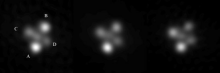
Gravitationally lensed quasar Q 2237 (Einstein Cross). Images were obtained one by one after a year. Angle resolution is 0.7". Changes of components can be observed
COIP has been successfully used to improve the images obtained with cameras of the first spaceborn missions to the Moon and planets.
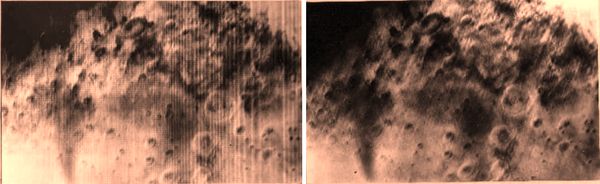
Outcome of linear filtration of Mars surface panoramas obtained by mechanical scanners on the boards of the space missions «Mars-4» and «Mars-5»
An important problem in nowadays astronomy is the revealing and searching of planetary systems near others stars in our Galaxy. Many different methods are using to solve this problem. One of the methods is searching the autocorrelation functions and Fourier spectra of eclipsed stars.
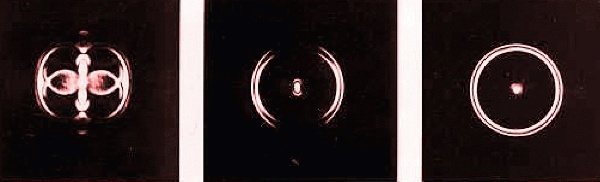
Autocorrelation functions for three overlapping stages of a "star" by its dark satellite
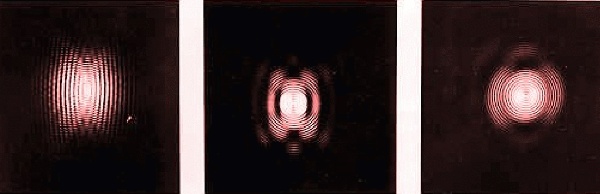
Fourier spectra for the three covering stages of a "star" by its dark satellite
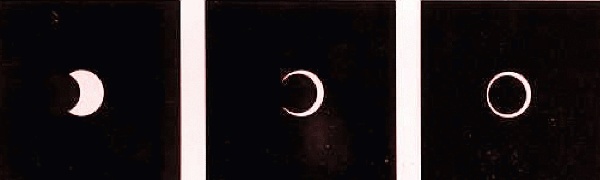
Original images of the models of stars covered by dark satellite
COIP in mode of laser extra-small phase-angle photometer
A lot of information about chemical composition and mineralogy, structure and physical properties of celestial bodies, natural or artificial surfaces can be acquired by remote spectrophotometrical methods. Analysis of phase curves of scattering surfaces, especially in range of very small phase angles ("opposition effect" at 5° - 0°), is one of it.
To provide laboratory photometry under phase-angles lower 0.01° we have developed an extra-small phases photometer that allows us to investigate the opposition effect in mentioned phase angles range. This photometer has been developed on base of the "Coherent-optical image processor". The smallest accessible phase angle is 0.008°; the angular resolution of the photometer is 0.005°; the angular diameter of light spot on target as it looks from the photometer position is about 0.11°.
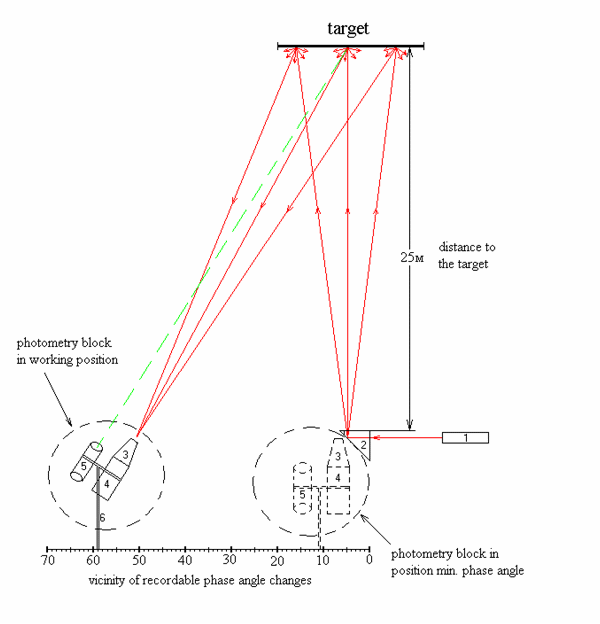
Optical scheme of laser photometer for extra-small phase angle range
1. The laser LGN-207A, (λ=0.63 μm, P=1.5 mW, diameter of light spot = 1.4 mm); 2. The prism of total internal reflection; 3. The obscure-camera (diameter of input aperture is 2 mm); 4. The photomultiplier Hamamatsu H5783-01; 5. The correction spyglass (field of view is 2°); 6. the scrollable rotary support
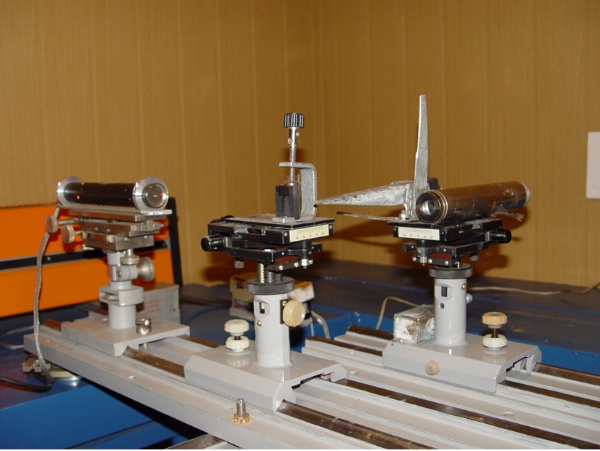
Laser light source, turn prism, and photometer are mounted on steel guiding rails, since it is important to provide high accuracy and stability of geometry parameters during measurements
Recent observations of Kuiper belt objects revealed noticeable spike in backscattering. It somewhat contradicts to low albedo of their surfaces, since low albedo is not in accordance with the coherent backscatter enhancement theory of the opposition effect. An important point is that the observations can be made only in the range of very small phase angles. To check and investigate the phenomenon, laboratory measurements of phase curves of surfaces with well-controlled properties at the same phase angles are very useful. We have made these measurements with the image processor.
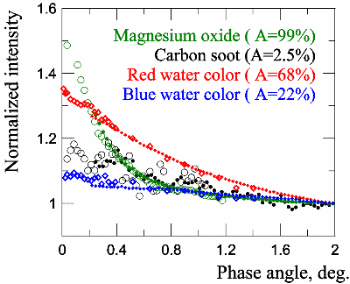
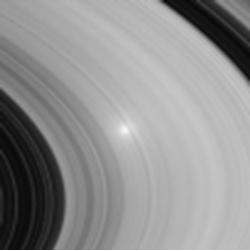
left: data of phase curves for laboratory samples in "opposition" obtained on the coherent processor (λ=0.63 μm); right: the opposition effect of Saturn rings as seen from the space mission "Cassini"